Oral Film Testing Laboratories: ISO/IEC 17025 Scope and Sample Handover
How oral dissolving strip buyers can check laboratory accreditation scope, finished-film method suitability and sample custody before commissioning testing.
Qualify an oral film testing laboratory by matching its current accreditation scope to the requested work, checking method suitability for the finished film, and agreeing sample custody and report requirements. Keep unresolved gaps visible before commissioning.
For oral strip brand, procurement and development teams. The review tools below are editorial recommendations. They do not assert that HYTANBIO holds laboratory accreditation or has performed these tests. Apply requirements according to product category and destination market.
Start with the decision the test must support
An oral dissolving strips manufacturer may send samples to several laboratories during an OEM or ODM project. One laboratory might measure an ingredient, another examine microbial quality, and another test packaging. A shared logo on their reports does not make the reports interchangeable.
Write the intended decision beside each test before requesting quotations: screen a prototype, compare a changed formula, support a stability time point, or inform batch release. Record the product category and destination market. A research result can help development without supplying the evidence required for a finished product release.
Make the test request specific
- Identify the finished oral film, formula revision, ingredient form and the property to be measured.
- State the reporting basis: per strip, per gram, per sachet or another clearly defined unit.
- Name the specification owner and attach the current approved specification.
- Ask which laboratory location will perform the work and whether any work will be subcontracted.
For a CRO or CDMO project, place this request alongside the development agreement. Keep responsibilities for sampling, testing, investigation and final disposition explicit.
Read the accreditation scope beside the certificate
ISO lists ISO/IEC 17025:2017 as edition 3, confirmed in 2023. Its subject is laboratory competence, impartiality and consistent operation. It does not establish an oral film formulation or grant product approval. ISO/IEC 17025:2017, edition 3; confirmed in 2023.
IAS explains that accreditation applies to specified activities. The scope can identify materials, methods, parameters and ranges. ISO 9001 certification addresses a quality management system; it is a different assessment from laboratory accreditation for particular testing activities. International Accreditation Service: testing laboratory accreditation FAQs.
Use a scope comparison worksheet
The following is a proposed procurement tool, not a prescribed accreditation form. Save a dated copy of the scope obtained from the issuing accreditation body’s directory. Resolve unclear wording directly with the laboratory before accepting the quotation.
| Review field | Evidence to request | Unresolved question |
|---|---|---|
| Laboratory identity | Legal name, address and accreditation identifier | Is the quoted testing site the listed location? |
| Material or matrix | Scope wording and explanation of coverage | How does the listed material relate to the finished film? |
| Method and revision | Method reference, version and any modification | Is the proposed procedure within the stated scope? |
| Parameter and range | Analyte, units and applicable measurement range | Can the requested level be reported on the agreed basis? |
| Reporting status | Clear identification of accredited and other work | Will subcontracted or outside-scope results be distinguished? |
A scope that uses flexible wording needs an explanation of what the laboratory is authorized to include. Do not infer coverage from an instrument name such as HPLC alone.
Check suitability for the finished oral film
A method offered for a raw ingredient needs a documented suitability assessment before its results are used for a film containing polymers, sweeteners, colors and flavors. Ask what evidence addresses that actual formulation and reporting purpose. This guide does not prescribe a sample preparation procedure or universal acceptance threshold.
For operations subject to U.S. dietary supplement CGMP, 21 CFR 111.320 requires verification that examination and testing methodologies suit their intended use, and an appropriate scientifically valid method for each specification requiring testing or examination. eCFR: 21 CFR 111.320.
Separate method questions from commercial promises
- Ask for the method identifier and a relevant validation or verification summary that the laboratory is permitted to share.
- Confirm how matrix effects, selectivity and the requested reporting level are addressed where relevant.
- Agree the reporting units, any conversion basis and the treatment of results below the reporting limit.
- Ask what evidence must be reassessed when the ingredient supplier, flavor, color or film composition changes.
A claim that a film dissolves quickly does not establish ingredient content, absorption or clinical performance. Those are separate questions with different evidence needs.
Keep the sample identity intact from dispatch to report
A technically capable laboratory still needs the correct sample. Build the handover record around identifiers that can be reconciled without guessing: project, formula revision, batch, packaging state and individual sample codes.
Agree the handover record before shipment
- List the quantity dispatched, package identifiers and requested tests on the submission form.
- Record dispatch date, transport instructions and any specified storage conditions.
- Ask the receiver to record arrival condition, damaged seals, missing units and deviations from instructions.
- Agree who may authorize additional work, how retained material is handled and how sample disposal is recorded.
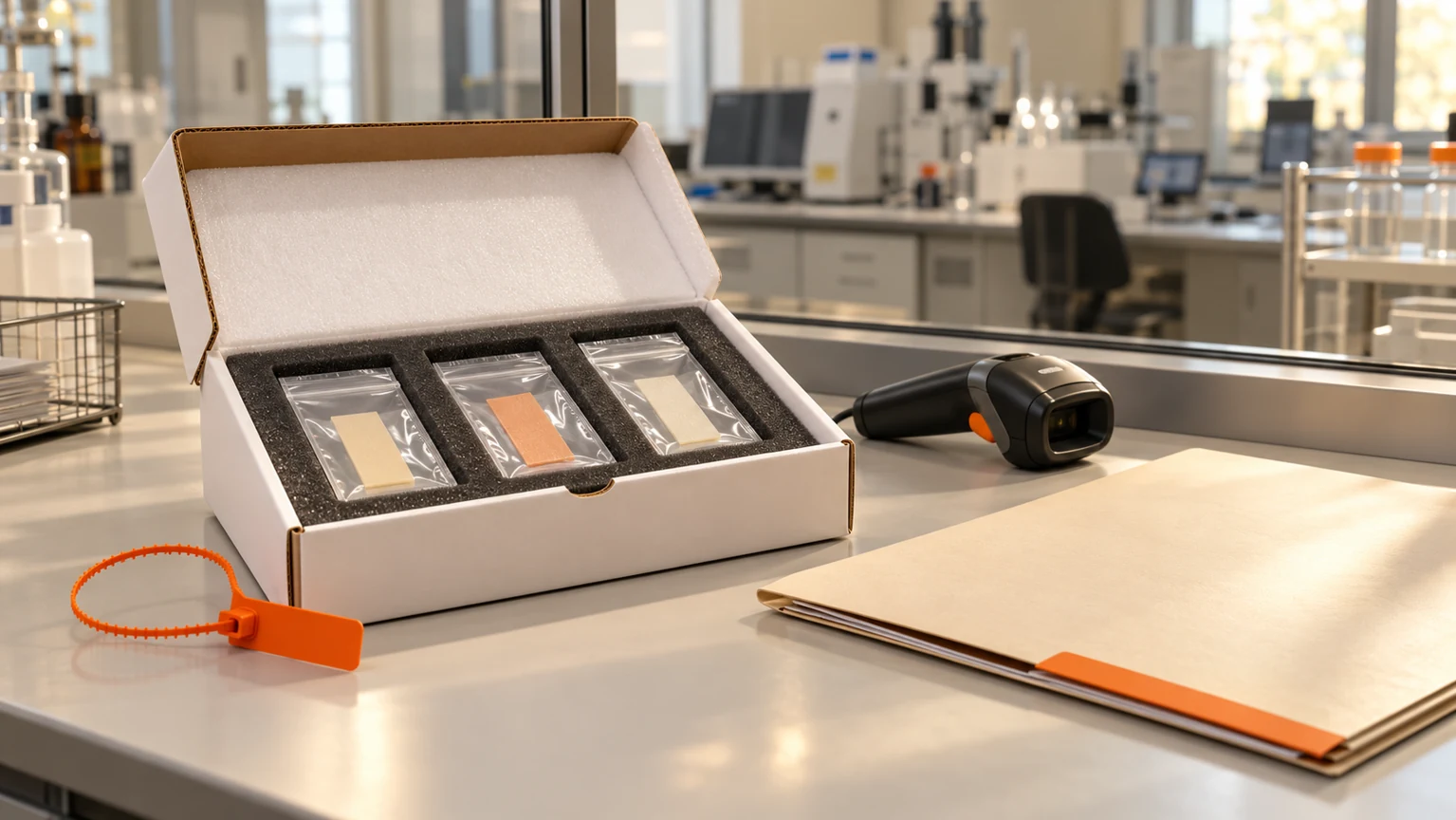
These are suggested contract controls. They are especially useful when a brand sends visually similar oral strips from more than one development batch. A photograph can show arrival condition; it cannot replace an unambiguous sample identifier.
Resolve gaps before using the report
Consider a hypothetical private-label project with a revised orange flavor. The quotation names an ingredient assay, but describes the material only as a powder. The buyer should ask the laboratory to explain the scope coverage and method suitability for the revised finished film, then document the agreed work. The wording alone is insufficient to decide either that the laboratory is unsuitable or that the test is covered.
Before commissioning, record the test scope, method revision, sample plan, report format, escalation contact and evidence still outstanding. Where a pass/fail conclusion is requested, agree the specification and how borderline results will be evaluated. Keep the underlying result and units available for review.
On receipt, reconcile the report to the submitted batch and requested work. Route discrepancies to the responsible quality reviewer. A marketing team should not convert an accreditation symbol into a claim that the product is approved, effective or accepted in every export market.
References and scope
- ISO/IEC 17025:2017, edition 3; confirmed in 2023. Laboratory competence, impartiality and consistent operation; the edition status is taken from the ISO catalogue.
- International Accreditation Service: testing laboratory accreditation FAQs. Accreditation scope, technical competence and the distinction from ISO 9001 certification.
- eCFR: 21 CFR 111.320. Laboratory method requirements for operations subject to U.S. dietary supplement CGMP.
References checked October 24, 2026. Laboratory standards and U.S. dietary supplement requirements have different scopes. No endorsement by the cited organizations is implied.
Frequently asked questions
Does ISO/IEC 17025 accreditation cover every oral film test?
Coverage depends on the laboratory location and activities listed in its scope. Compare the requested matrix, parameter, method and range with that scope, and obtain clarification where the wording is unclear.
Can ISO 9001 certification replace a laboratory scope review?
ISO 9001 certification concerns a quality management system. For a laboratory selected on the basis of ISO/IEC 17025 accreditation, review the specific testing activities covered and their relevance to the requested work.
Can a raw ingredient method be used for a finished oral strip?
It needs an assessment of suitability for the finished formulation and intended purpose. Ask for relevant supporting evidence, including the reporting basis and how the formulation matrix is addressed. Do not assume that the ingredient name alone establishes suitability.
Does an accredited report approve a private-label oral strip for sale?
No. A test report addresses the submitted sample and stated testing work. Product classification, permitted ingredients, labeling and market access need their own review for the intended destination.