Choosing polymers and plasticizers for oral dissolving strips
Compare film-forming polymer grades and plasticizer ratios using defined solids, conditioning and sample tests before approving an oral film formula.
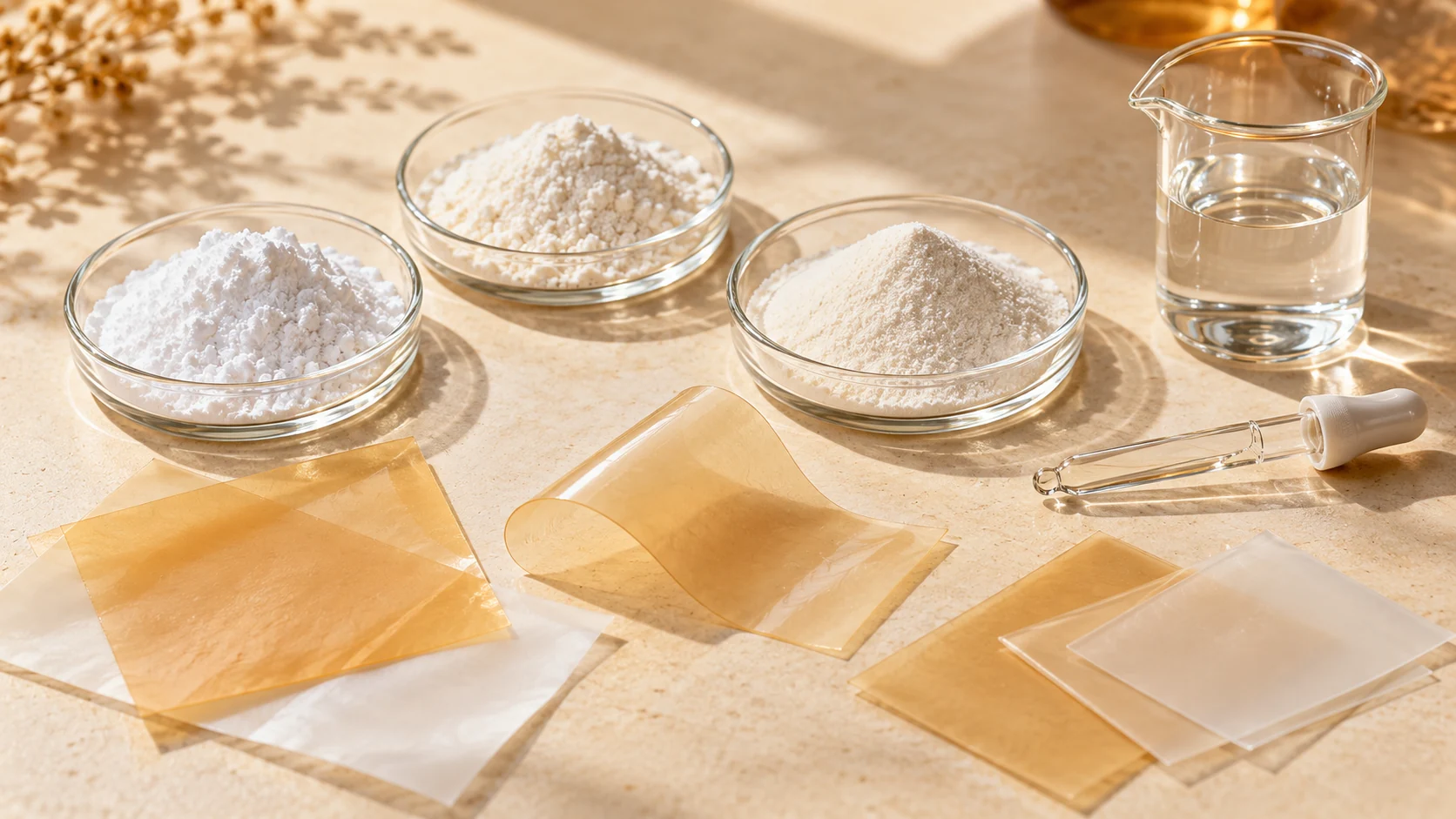
Select an oral film polymer by its specific grade and performance in the intended formulation. Compare plasticizer amounts on a declared basis, then test films prepared and conditioned consistently. A familiar ingredient name is not evidence of equivalent film behavior.
This guide uses published pharmaceutical-film experiments as formulation background. It does not prescribe a finished formula, grant ingredient eligibility or claim that HYTANBIO reproduced the cited studies.
Define the strip before choosing its polymer
“Use HPMC” leaves much of an oral film formulation unspecified. Hypromellose, also known as hydroxypropyl methylcellulose, is supplied in different grades. A development brief needs the proposed grade, its supplier specification and the reason it suits the casting process. The same discipline applies to pullulan, polyvinyl alcohol and polymer blends.
Start with the finished strip’s requirements: intended dimensions, ingredient loading, removal from the release surface, handling during individual packing and the required dispersion behavior. Describe these as observable or measurable criteria. A strip that peels easily in a laboratory trial still needs examination in its proposed package and after the agreed conditioning.
Separate material identity from formulation function
The material’s name establishes what is being proposed. The prototype establishes how that grade behaves with the other ingredients under a defined process. Retain both records. Substituting a different supplier’s material by name alone can create a new comparison, even where both materials meet the same basic specification.
Compare candidates with a question-led matrix
| Candidate | Question for the development brief | Record to retain |
|---|---|---|
| HPMC / hypromellose | Which grade and preparation conditions produce the required casting behavior? | Grade specification, dispersion sequence and viscosity method |
| Pullulan | Does the complete formulation need viscosity adjustment or another polymer? | Blend identity, solution handling and film observations |
| PVA or a PVA-containing blend | How does the specified grade behave during preparation, drying and peeling? | Grade and blend ratio, process conditions and mechanical results |
| Maltodextrin-containing blend | How does changing the blend alter handling and dispersion together? | Material grade, blend proportions and matched prototype results |
These are experimental questions, not a ranking of polymers. A 2022 primary study of pullulan and maltodextrin films used a Box–Behnken design to examine polymer proportions and propylene glycol. It evaluated several responses, including tensile strength and disintegration. The useful lesson for a purchasing brief is to retain the trade-offs between responses, not copy the study’s selected formulation. Shah and colleagues.
Review ingredient eligibility for the intended product category separately from this performance comparison. A paper describing a pharmaceutical film does not establish that every ingredient or grade is suitable for a dietary-supplement project in every destination market.
State exactly what the plasticizer percentage means
A formulation sheet saying “20% glycerol” is incomplete until it names the denominator. The percentage could refer to dry polymer, total dry solids or the wet casting mixture. Those bases give different quantities.
A numerical example of the denominator problem
Consider a hypothetical blend containing 100 g of dry polymer and 20 g of glycerol, with no other solids included in this calculation. Glycerol is 20% relative to the polymer mass, but 16.7% of their combined 120 g mass. Neither figure states its percentage in a wet solution containing additional water. This is an arithmetic example, not a recommended oral film recipe.
Put the denominator in the formula and in the trial report. Also record the material grade, addition sequence and whether the stated amount is based on a supplied solution or its declared active content. A percentage copied from another project’s worksheet can otherwise change the trial unintentionally.
In a primary HPMC E6 study, researchers examined polymer concentrations of 2%, 2.5% and 3% with different plasticizers and characterized the resulting films. The experimental design illustrates why polymer concentration and plasticizer choice should be identified together. Its drug-containing formulations are not commercial instructions for the films on this website. Da Silva and colleagues.
Use matched prototypes to expose the trade-offs
Assign a version to each candidate formulation. Keep ingredient loading, casting area, drying history and conditioning comparable unless one is the variable under study. Retain the actual prepared amounts and observations rather than only the intended recipe.
- Record whether the solution or dispersion can be prepared without persistent agglomerates or air defects.
- Inspect the film’s two surfaces and document its removal from the release surface.
- Assess flexibility and tack using the agreed procedures and conditioning.
- Measure the properties that will determine approval, including dispersion behavior where relevant.
- Keep an individual sachet trial in the comparison if packing and opening are important to the project.
Use the same mechanical method when comparing tensile strength or elongation results. Record specimen dimensions, thickness measurement, test settings and conditioning. A fold count and an elongation-at-break result describe different procedures; presenting both as “flexibility” hides the distinction.
Watch the interaction with humidity and processing
A 2025 comparison of hot-melt-extruded and solvent-cast films reported that processing and humidity affected film properties. This supports carrying preparation and conditioning records through the comparison. It does not mean that either manufacturing route is universally preferable. Primary comparative study.
Approve a formulation version with a usable record
Record the chosen polymer grade, plasticizer identity, quantities and reporting basis in the approved formula. Attach the prototype identifier, results, conditioning and the decisions on appearance, peeling and packaging. List any behavior that remains unresolved instead of turning a provisional sample into a production specification.
When a candidate is rejected, retain the reason. “Too sticky after conditioning” and “difficult to remove from liner” point to different development tasks. A general score such as “poor quality” gives the next scientist or supplier little information.
Use the blinded sample review guide for sensory comparisons, and connect moisture-related observations to the water activity and moisture guide. If a material grade or supplier later changes, reopen the relevant comparison using the supplier change checklist.
For OEM or ODM development, provide the required film behavior and existing ingredient constraints. The project can then define the experiments and evidence needed before committing to a particular polymer system.
Sources and scope
- Shah et al., Materials 2022, 15(10), 3591; DOI 10.3390/ma15103591. Primary pullulan/maltodextrin formulation study using a Box–Behnken design.
- Da Silva et al., Brazilian Journal of Pharmaceutical Sciences 2023; DOI 10.1590/s2175-97902023e21114. Primary HPMC E6 and plasticizer study.
- Orodispersible films prepared by hot-melt extrusion versus solvent casting (2025). Primary comparison of process, humidity and physical film behavior.
References checked October 30, 2026. The cited research and standards have their own scopes. The proposed review tools are editorial applications, and no endorsement by the cited organizations is implied.
Frequently asked questions
Is one polymer always best for oral dissolving strips?
No universal choice follows from the polymer name. Compare the specified grade in the complete formulation and process against the project's handling, packaging and dispersion requirements.
What should a plasticizer percentage include?
State the plasticizer identity, quantity and denominator, such as dry polymer, total dry solids or wet mixture. Those reporting bases are different.
Can a published pharmaceutical formulation be copied into a supplement project?
It can inform experimental questions. The finished formulation still needs ingredient eligibility, performance and market review for its own product category.
Can two flexibility results be compared directly?
Only after the procedures and conditions are reconciled. Folding endurance, tensile strength and elongation at break are different measurements; specimen preparation and conditioning also need to be stated.